
Devon Reed · 5 September 2026
Navigating Resource Compilation Challenges in Niche Digital Ecosystems
Resource compilation in niche digital ecosystems involves gathering, organizing, and maintaining specialized information across platforms that serve focused communities such as independent developers, academic researchers in emerging fields, and hobbyist groups with narrow technical interests. These ecosystems often operate outside mainstream search engines and rely on fragmented data sources that include private forums, archived repositories, and user-generated databases. Observers note that the process requires careful coordination to avoid duplication while ensuring accuracy across multiple contributors who may operate under different access protocols.
Core Difficulties in Data Aggregation
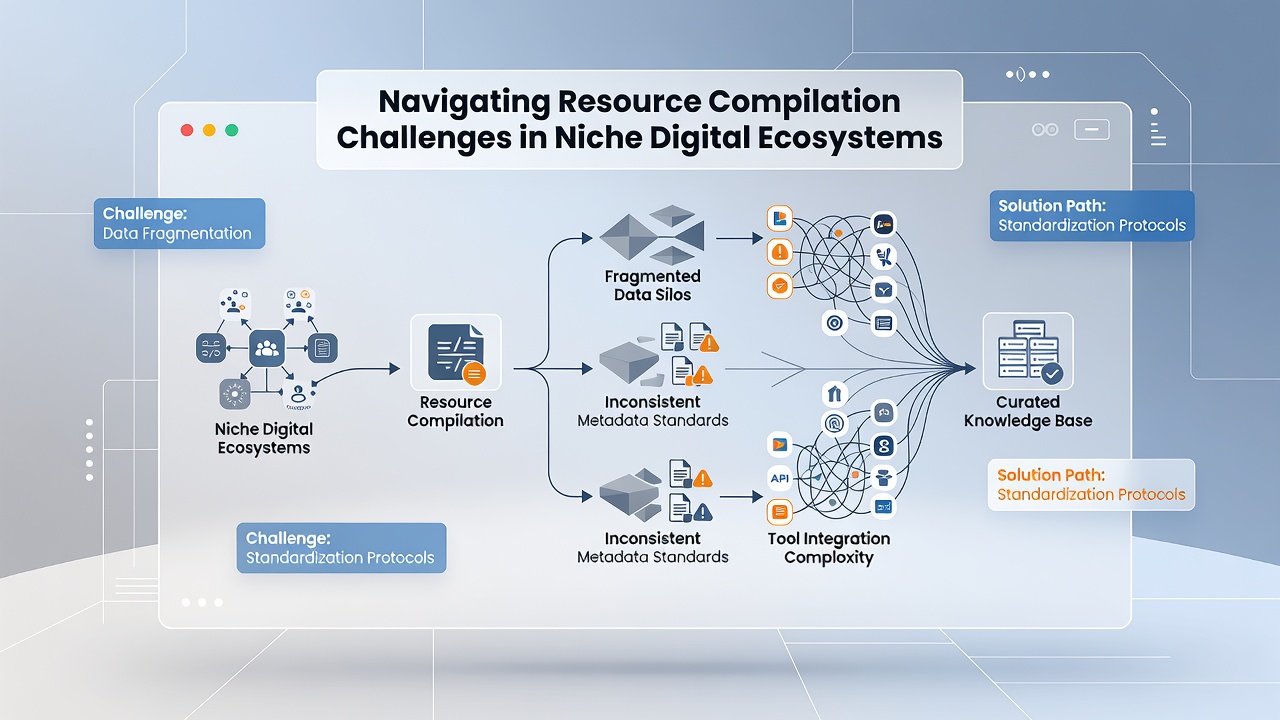
Specialized communities face persistent issues when attempting to centralize scattered materials because many niche platforms use proprietary formats that resist standard indexing tools. Data shows that synchronization problems arise frequently when contributors work across time zones and employ inconsistent tagging systems. Research from the OECD indicates that ecosystems centered on topics like open-source hardware or regional language preservation encounter higher rates of incomplete records compared with broader digital spaces. Participants must navigate authentication barriers on closed servers while cross-referencing materials that lack standardized metadata.
Quality verification adds another layer because niche content often includes unpublished datasets or community-specific annotations that require domain expertise to evaluate. Figures from a 2025 Canadian Digital Economy Survey reveal that 62 percent of respondents in targeted online groups reported spending over 40 percent of their compilation time on validation steps alone. Those who study these patterns find that automated scripts frequently fail to catch contextual errors unique to the ecosystem in question.
Technical and Organizational Barriers
Legacy systems still dominate many smaller digital communities, which creates compatibility hurdles when new compilation tools enter the workflow. Experts have documented cases where older database structures reject modern API calls, forcing manual transfers that increase error rates. In September 2026 the European Commission plans to release updated guidelines on interoperable data standards for digital content platforms, a development that may ease some integration tasks for groups already working with EU-hosted archives. Yet organizations must weigh these potential benefits against the cost of retraining volunteers who maintain the repositories.
Access rights represent an ongoing concern as well. Many niche ecosystems depend on invite-only sections or require membership verification that limits external scraping or bulk downloads. Studies conducted by the University of Melbourne's Digital Futures Lab found that ecosystems focused on indigenous knowledge preservation impose strict controls to protect sensitive cultural materials, resulting in slower compilation cycles. Contributors often rely on tiered permission models that balance openness with protection requirements.
Approaches That Improve Outcomes
Communities that adopt modular compilation frameworks report better success rates because these systems allow incremental updates without full database rebuilds. Data from industry reports compiled by the Information Technology and Innovation Foundation shows that groups using version-controlled repositories reduce duplication incidents by approximately 35 percent. Clear governance policies help as well, with defined roles for reviewers and editors that prevent conflicting edits from accumulating over time.
Training programs tailored to the ecosystem's specific tools further support consistency. Participants learn to apply consistent schemas early in the collection phase, which reduces downstream cleanup efforts. Observers note that partnerships with academic institutions sometimes supply technical expertise and temporary hosting resources that smaller groups cannot maintain independently.
Looking Ahead
Continued evolution of data standards and cross-platform protocols should gradually lower some barriers, although adoption remains uneven across different niche sectors. Entities tracking these trends continue to monitor regulatory shifts expected in late 2026, particularly those affecting cross-border data flows. Successful navigation ultimately depends on sustained collaboration among contributors who understand both the technical constraints and the community norms that shape each ecosystem.
Conclusion
Resource compilation in these specialized environments demands ongoing attention to format compatibility, access controls, and verification processes. Organizations that implement structured workflows and leverage emerging interoperability guidelines stand to improve efficiency without compromising the integrity of the materials they maintain.